Monday, September 7, 2009
SRAC September Fundraisers
The Susquehanna River Archaeological Center (SRAC) is gearing up for a rummage sale / fund raiser September 17, 18, and 19th. This event will occur in tandem with the current "Big Book Sale" taking place at the Center throughout the month of September. Anyone wishing to donate books or other items (excluding clothes) for either event to support SRAC are asked to drop off items during normal business hours. SRAC is a 501(c)3 nonprofit located at 345 Broad St., Waverly, NY. Their business hours are Tuesdays through Fridays from 1-5pm, and Saturdays from 11am - 4pm. For more information, please email info@SRACenter.org, or call the Center at 607-565-7960.


Friday, September 4, 2009
The Englebert Site - By April Beisaw 2007
This is a followup from my first post about the Englebert site. (make sure to read the comments !)
The following video of April Beinsaw, PhD who did her dissertation at SUNY Binghamton concerning the Englebert Site available from SRAC's Online Videos. Her presentation, "The Englebert Site - Susquehannock or Iroquois" was given in May 2007 at the Joint SRAC /Andaste Chapter of Pennsylvania Archaeology meeting in Burlington, PA:

The following video of April Beinsaw, PhD who did her dissertation at SUNY Binghamton concerning the Englebert Site available from SRAC's Online Videos. Her presentation, "The Englebert Site - Susquehannock or Iroquois" was given in May 2007 at the Joint SRAC /Andaste Chapter of Pennsylvania Archaeology meeting in Burlington, PA:
Click the image below to watch the video now.
Please post your comments by clicking the comments link at the bottom of this posting.
Wednesday, September 2, 2009
SRAC Book Sale!

Children get their first book free and each book after that for 10 cents!
Seniors get 50% off the Adult pricing!
SRAC is having an ongoing used book sale - and are asking for donations of hard and soft cover books. We are taking drop offs at SRAC between 1-5pm Tuesdays through Fridays and Saturdays from 11-4pm. The book sale will continue throughout September and include a rummage sale September 17-19.
Please consider dropping off some books or rummage sale items (excluding clothes) to help us with this fundraiser - Winter is coming- - and so are those heating bills!
( ;
Tuesday, September 1, 2009
Bears On Broad Street Gallery
Thank you to everyone who made the Bears on Broad Street a HUGE success!
Click HERE to go to the Picture Gallery!
The Englebert Site
This past weekend I was sent news articles that reported that all of the remains and artifacts from the Englebert site will be given to the Onondaga Nation as the result of a NAGPRA agreement that was made some years ago.
There are so many issues in my opinion concerning this that at first I did not even know where to begin with it. As a result, I decided to begin with just a small spattering of some direct quotes from our earliest known historical records about the Andastes and their relationship with the Iroquois Nation and specifically the Onondaga Nation. The following are actual accounts from Jesuit missionary priests who lived among the Iroquois in the 17th century. I am giving you the volume and basic year so that you the reader can read as much as you like from these accounts. ALL can be accessed from http://www.spanishhill.com/jesuit_relations/
PREFACE TO Jesuit Relations VOL. XLV (1659)
“Lalemant (Jesuit priest) sketches the history, character, and political condition of the Iroquois tribes. They had been, in the past, defeated and crushed by both the Algonkins and the Andastes; but, of late, have in turn almost annihilated those tribes.”
MISSION OF ONNONTAGUÉ.(Onondaga) Jesuit Relations VOL. LIX. (1675)
FATHER Jean de Lamberville is at Onnontague; this is the village of the third nation, where Garakontié continues to give evidence of his firmness in the faith, and of his friendship for the French.
The Father has acquired great influence by his skill in using various remedies. This gives him entrance to all the cabins and access to all the sick, so that few escape who are not baptized before they die. In addition to his occupation in Onnontagué, he is compelled from time to time to make excursions in the vicinity. On the last one that he made, ten leagues from the village, he fortunately arrived in time to baptize a dying man, who expired shortly afterward. Then, after crossing a river, he found several sick Christians, whom he confessed; he then bled them, and it came to pass that, by means of the spiritual and temporal remedies, God restored them to health. He also baptized, at the same place, a man and a woman who were very well disposed. At the same time, he had to endeavor to prepare for that [Page 243] sacrament a woman who had a great aversion to the French and to the Faith. He succeeded so well that she was worthy of receiving baptism before she died. He had barely finished when he was obliged Promptly to recross the river, to bleed a sick juggler; but, as he did not deem him worthy of baptism, the Father set out at once to go two leagues from there, and administer it to a woman and a child, who at the same time were restored to health through the medicines which he gave them.Thus a missionary must be all things to all men, allowing no opportunity to escape him for winning souls to Jesus Christ, This is what the Father does both in and out of Onnontague. Consequently he has this year increased his church by seventy-two Christians, forty of whom died after baptism, as well as many adults; among these were some captives from Andastogué whom he baptized amid the fires in which they died.
CHAPTER VI. OF THE MISSION OF ST. FRANÇOIS XAVIER AT ONNEIOUT. Jesuit Relations – Vol. LIII (1669-1670)
“The 30th. They begin to burn her over a slow fire, and prolong her torture for the space of two days and two nights, — because he for whom she was given was burned at Andastogué for that length of time.
To me, it does not seem from these narratives that the Andastes were friends with the Iroquois nation or the Onondaga. As a result, I wonder how the association and ancestral connection (making the Onondaga the Susquehannock modern descendants) was decided upon between the two in order for the transference of remains to occur. Again – I am not afraid to claim ignorance and this is just my opinion - so I hope that someone can send me this information to help me understand all of this a little better.
The Site
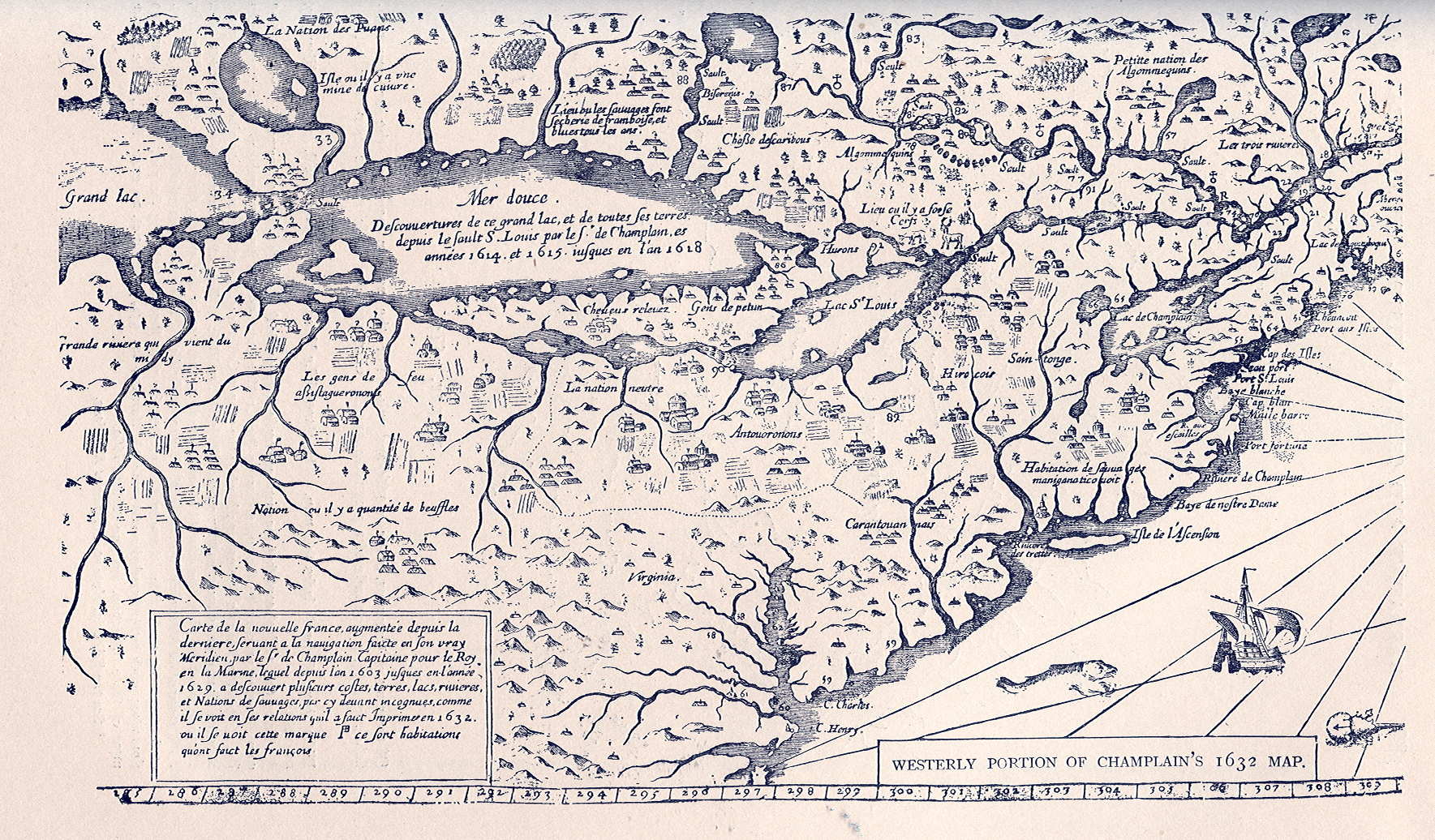
I have had great interest in the Englebert site ever since I started studying Carantoun – about which I published an article in the PA Archaeologist in 2005. Carantouan was the nation of Andastes that Etienne Brule visited in 1615 in order to bring 500 of their warriors to help Samuel Champlain and the Hurons in a battle against the Onondagas. You can read all about this at Spanishhill.com if you are not familiar with this story…Note the map shown here.
In recounting this story, Champlain made a map in 1632 of his travels and he illustrates Brule’s path to Carantouan and also shows where the villages and the ceremonial space (Spanish Hill) was located. As you can see there were just as Champlain explained three villages. And the northern most has a flag even. Well folks…I believe this is exactly where the Englebert site was found 350 years later.
The Englebert site located on a 20-acere gravel knoll was excavated as a salvage operation that uncovered 140 burials while a highway was being constructed near Nichols, NY. In the end, the site was the largest Andaste cemetery that I know of ever being found. During the excavation, the Tri Cities Chapter of NY Archaeology and many volunteers led by Dolores Eliot feverishly dug and recorded burial after burial as the bulldozers worked right behind them. Dan Caister, president of the Tri-Cities Chapter actually did a presentation about this for us that I videotaped.I believe the Englebert family also were present and talked after the presentation on this tape too. Dan also did an article in our newsletter in 2007 about the site which began with,
“The most important fact about the Engelbert site near Nichols, NY, is that it was repeatedly used as a cemetery by the ancestors of the Iroquois for 600 years from 950 A.D. to 1550 A.D…
The second most important fact about this key site is that it’s gone...”
Today, Dan couldn’t have said it any better. But over the summers of 1967-68, when the excavation occurred, the remains and the grave goods from 140 burials of the Late Woodland residents of the Susquehanna Valley were all boxed up and eventually made their way to SUNY Binghamton. In his report, Dan stated, “Based on the artifacts interred in the graves, most of the burials dated to the Late Owasco, Protohistoric and Early Contact periods. These estimates are based on pottery styles, pottery technology, and copper artifacts in a few burials which suggest the presence of European trade goods. Other features—hearths or storage pits—contained artifacts from the Late Archaic period around 4000 years ago.” Lastly he raised the question that perked my interests when he said, “Another question which may never be answered is whether this was an occupation site—a village or hamlet—at some times and a cemetery at other times. The site was certainly occupied at least intermittently during the Late Archaic period. The amount of pottery and stone tools in non-burial contexts, the presence of deep storage pits, and a line of possible postmolds suggest that the hilltop may also have been occupied during at least part of the Late Woodland period.”
Since Brule WAS the early European contact for Carantouan which I believe the Englebert site WAS a part of - and the copper goods that were found at the site occur generally in sites dated from 1600-1625 – AND there was possible evidence of post molds and thus living spaces - Again, I hope that you can understand my interests relative to Brule’s trip to Carantouan which occurred in 1615.
Unfortunately – I am not an archaeologist or anthropologist and have been hoping to someday get the professionals here to research the evidence found in the region of Carantouan to include the Englebert site. It is my hope that this could answer the questions surrounding Carantouan, Spanish Hill and the three village sites on Champlain's map once and for all.
...And then I received the email that said that soon, most of this evidence from the Englebert site will be gone!
And when I went back to read Dan Caister's article - he actually even told us in 2007, " The Native American remains have been or will be repatriated to the Iroquois nations under the terms of the Native American Graves and Patrimony Repatriation Act. The burial goods interred with the prehistoric human remains will also be returned to their modern descendants. But soil samples, artifacts recovered outside of the burials, animal remains and botanical remains are still available for study and reveal `some fascinating information about the prehistory of this area. "
I know what you are thinking at this point…
I know that you are thinking that I am upset that the remains are being re-interred, right?
Well let’s think about this a little bit…
The site was excavated 41 years ago. So my question is what research was done on it for the nearly half a century that it was in those boxes? The only extensive reports that I know of are as follows:
Most Recent: SUNY Binghamton, April Beinsaw, PhD – her dissertation was on the Englebert Site and SRAC had her present her research. Watch it here.
I found three articles in the NYSAA Bulletin that were written over the years as well:
Bulletin No. 58, July 1973 - A PROTO-HISTORIC SUSQUEHANNOCK CEMETERY - NEAR NICHOLS, TIOGA COUNTY, NEW YORK - Marilyn Stewart
Bulletin Volume 61: July 1974 - Copper Artifacts From The Engelbert Site 1 - Helene R. Dunbar and Katharine C. Ruhl
Bulletin Volume 80 and 81: Fall 1981 – Spring 1981: Historic Ceramics from the Engelbert Site: An Evaluation of Artifacts from a Salvage 19 Operation - Charles Semowich
Lastly there is small booklet that showed photos of many of the burials that was created that is quite hard to find these days. SUNY Binghamton might have some left they would send out and SRAC does have one however that can be used in house and for research purposes & by request only.
And that folks is the grand sum total of all that I have been able to acquire on info about the Englebert Site and any research done on the materials found there over the last 40 years.
Some would say that is enough.
I would say that it is just the tip of the iceberg of what should have been done and feel that SRAC whose mission is to promote more archaeological research in the area should have been more of a catalyst concerning this issue.
But no matter what ANYONE says, it is all that there will ever be done using the skeletal remains and artifacts found in the burials there.
I hope that those mighty Susquehannocks who gave us 41 years to learn what we could from their remains can rest in peace soon - - even though they know (as we all do) that we did not.
Shame on US.
POST COMMENTS AND ADDITIONAL INFO USING THE COMMENTS LINK BELOW!
I also hope that all of the readers that have comments on this are responsible enough to post it to the bottom of this blog by clicking the comments link found there. In this way ALL of this info will remain linked to this topic for anyone wanting to know about this site and its fate for years to come. Feedback is as always welcome as well.
Please note that the opinions stated here are ALL MINE, and are not meant to represent those of SRAC or any other party.
There are so many issues in my opinion concerning this that at first I did not even know where to begin with it. As a result, I decided to begin with just a small spattering of some direct quotes from our earliest known historical records about the Andastes and their relationship with the Iroquois Nation and specifically the Onondaga Nation. The following are actual accounts from Jesuit missionary priests who lived among the Iroquois in the 17th century. I am giving you the volume and basic year so that you the reader can read as much as you like from these accounts. ALL can be accessed from http://www.spanishhill.com/jesuit_relations/
PREFACE TO Jesuit Relations VOL. XLV (1659)
“Lalemant (Jesuit priest) sketches the history, character, and political condition of the Iroquois tribes. They had been, in the past, defeated and crushed by both the Algonkins and the Andastes; but, of late, have in turn almost annihilated those tribes.”
MISSION OF ONNONTAGUÉ.(Onondaga) Jesuit Relations VOL. LIX. (1675)
FATHER Jean de Lamberville is at Onnontague; this is the village of the third nation, where Garakontié continues to give evidence of his firmness in the faith, and of his friendship for the French.
The Father has acquired great influence by his skill in using various remedies. This gives him entrance to all the cabins and access to all the sick, so that few escape who are not baptized before they die. In addition to his occupation in Onnontagué, he is compelled from time to time to make excursions in the vicinity. On the last one that he made, ten leagues from the village, he fortunately arrived in time to baptize a dying man, who expired shortly afterward. Then, after crossing a river, he found several sick Christians, whom he confessed; he then bled them, and it came to pass that, by means of the spiritual and temporal remedies, God restored them to health. He also baptized, at the same place, a man and a woman who were very well disposed. At the same time, he had to endeavor to prepare for that [Page 243] sacrament a woman who had a great aversion to the French and to the Faith. He succeeded so well that she was worthy of receiving baptism before she died. He had barely finished when he was obliged Promptly to recross the river, to bleed a sick juggler; but, as he did not deem him worthy of baptism, the Father set out at once to go two leagues from there, and administer it to a woman and a child, who at the same time were restored to health through the medicines which he gave them.Thus a missionary must be all things to all men, allowing no opportunity to escape him for winning souls to Jesus Christ, This is what the Father does both in and out of Onnontague. Consequently he has this year increased his church by seventy-two Christians, forty of whom died after baptism, as well as many adults; among these were some captives from Andastogué whom he baptized amid the fires in which they died.
CHAPTER VI. OF THE MISSION OF ST. FRANÇOIS XAVIER AT ONNEIOUT. Jesuit Relations – Vol. LIII (1669-1670)
“The 27th. Two Elders from Onnontagué bring the news of the return of their warriors, with nine Andastogué captives that were surprised while hunting. Two of them were given to Onneiout, — a Young man of twenty, and a woman. This woman was baptized at Onnontagué by Father Millet.
“The 30th. They begin to burn her over a slow fire, and prolong her torture for the space of two days and two nights, — because he for whom she was given was burned at Andastogué for that length of time.
To me, it does not seem from these narratives that the Andastes were friends with the Iroquois nation or the Onondaga. As a result, I wonder how the association and ancestral connection (making the Onondaga the Susquehannock modern descendants) was decided upon between the two in order for the transference of remains to occur. Again – I am not afraid to claim ignorance and this is just my opinion - so I hope that someone can send me this information to help me understand all of this a little better.
The Site

I have had great interest in the Englebert site ever since I started studying Carantoun – about which I published an article in the PA Archaeologist in 2005. Carantouan was the nation of Andastes that Etienne Brule visited in 1615 in order to bring 500 of their warriors to help Samuel Champlain and the Hurons in a battle against the Onondagas. You can read all about this at Spanishhill.com if you are not familiar with this story…Note the map shown here.
In recounting this story, Champlain made a map in 1632 of his travels and he illustrates Brule’s path to Carantouan and also shows where the villages and the ceremonial space (Spanish Hill) was located. As you can see there were just as Champlain explained three villages. And the northern most has a flag even. Well folks…I believe this is exactly where the Englebert site was found 350 years later.
The Englebert site located on a 20-acere gravel knoll was excavated as a salvage operation that uncovered 140 burials while a highway was being constructed near Nichols, NY. In the end, the site was the largest Andaste cemetery that I know of ever being found. During the excavation, the Tri Cities Chapter of NY Archaeology and many volunteers led by Dolores Eliot feverishly dug and recorded burial after burial as the bulldozers worked right behind them. Dan Caister, president of the Tri-Cities Chapter actually did a presentation about this for us that I videotaped.I believe the Englebert family also were present and talked after the presentation on this tape too. Dan also did an article in our newsletter in 2007 about the site which began with,
“The most important fact about the Engelbert site near Nichols, NY, is that it was repeatedly used as a cemetery by the ancestors of the Iroquois for 600 years from 950 A.D. to 1550 A.D…
The second most important fact about this key site is that it’s gone...”
Today, Dan couldn’t have said it any better. But over the summers of 1967-68, when the excavation occurred, the remains and the grave goods from 140 burials of the Late Woodland residents of the Susquehanna Valley were all boxed up and eventually made their way to SUNY Binghamton. In his report, Dan stated, “Based on the artifacts interred in the graves, most of the burials dated to the Late Owasco, Protohistoric and Early Contact periods. These estimates are based on pottery styles, pottery technology, and copper artifacts in a few burials which suggest the presence of European trade goods. Other features—hearths or storage pits—contained artifacts from the Late Archaic period around 4000 years ago.” Lastly he raised the question that perked my interests when he said, “Another question which may never be answered is whether this was an occupation site—a village or hamlet—at some times and a cemetery at other times. The site was certainly occupied at least intermittently during the Late Archaic period. The amount of pottery and stone tools in non-burial contexts, the presence of deep storage pits, and a line of possible postmolds suggest that the hilltop may also have been occupied during at least part of the Late Woodland period.”
Since Brule WAS the early European contact for Carantouan which I believe the Englebert site WAS a part of - and the copper goods that were found at the site occur generally in sites dated from 1600-1625 – AND there was possible evidence of post molds and thus living spaces - Again, I hope that you can understand my interests relative to Brule’s trip to Carantouan which occurred in 1615.
Unfortunately – I am not an archaeologist or anthropologist and have been hoping to someday get the professionals here to research the evidence found in the region of Carantouan to include the Englebert site. It is my hope that this could answer the questions surrounding Carantouan, Spanish Hill and the three village sites on Champlain's map once and for all.
...And then I received the email that said that soon, most of this evidence from the Englebert site will be gone!
And when I went back to read Dan Caister's article - he actually even told us in 2007, " The Native American remains have been or will be repatriated to the Iroquois nations under the terms of the Native American Graves and Patrimony Repatriation Act. The burial goods interred with the prehistoric human remains will also be returned to their modern descendants. But soil samples, artifacts recovered outside of the burials, animal remains and botanical remains are still available for study and reveal `some fascinating information about the prehistory of this area. "
I know what you are thinking at this point…
I know that you are thinking that I am upset that the remains are being re-interred, right?
Well let’s think about this a little bit…
The site was excavated 41 years ago. So my question is what research was done on it for the nearly half a century that it was in those boxes? The only extensive reports that I know of are as follows:
Most Recent: SUNY Binghamton, April Beinsaw, PhD – her dissertation was on the Englebert Site and SRAC had her present her research. Watch it here.
I found three articles in the NYSAA Bulletin that were written over the years as well:
Bulletin No. 58, July 1973 - A PROTO-HISTORIC SUSQUEHANNOCK CEMETERY - NEAR NICHOLS, TIOGA COUNTY, NEW YORK - Marilyn Stewart
Bulletin Volume 61: July 1974 - Copper Artifacts From The Engelbert Site 1 - Helene R. Dunbar and Katharine C. Ruhl
Bulletin Volume 80 and 81: Fall 1981 – Spring 1981: Historic Ceramics from the Engelbert Site: An Evaluation of Artifacts from a Salvage 19 Operation - Charles Semowich
Lastly there is small booklet that showed photos of many of the burials that was created that is quite hard to find these days. SUNY Binghamton might have some left they would send out and SRAC does have one however that can be used in house and for research purposes & by request only.
And that folks is the grand sum total of all that I have been able to acquire on info about the Englebert Site and any research done on the materials found there over the last 40 years.
Some would say that is enough.
I would say that it is just the tip of the iceberg of what should have been done and feel that SRAC whose mission is to promote more archaeological research in the area should have been more of a catalyst concerning this issue.
But no matter what ANYONE says, it is all that there will ever be done using the skeletal remains and artifacts found in the burials there.
I hope that those mighty Susquehannocks who gave us 41 years to learn what we could from their remains can rest in peace soon - - even though they know (as we all do) that we did not.
Shame on US.
POST COMMENTS AND ADDITIONAL INFO USING THE COMMENTS LINK BELOW!
I also hope that all of the readers that have comments on this are responsible enough to post it to the bottom of this blog by clicking the comments link found there. In this way ALL of this info will remain linked to this topic for anyone wanting to know about this site and its fate for years to come. Feedback is as always welcome as well.
Please note that the opinions stated here are ALL MINE, and are not meant to represent those of SRAC or any other party.
Saturday, August 29, 2009
28th Annual Iroquois Indian Festival
Iroquois Indian Museum Announces the 28th Annual Iroquois Indian Festival
September 5 & 6 from 10am-6pm Rain or Shine
The Iroquois Indian Museum of Howes Cave, New York, announces the 28th Annual Iroquois Indian Festival to be held on Labor Day weekend, Saturday, September 5 through Sunday, September 6. The two-day festival’s goal is to foster a greater appreciation and deeper understanding of Iroquois culture through presentations of Iroquois music and social dance, traditional stories, artwork, games and food. This year’s master of ceremonies will be Museum Educator, Mike Wahrare Tarbell, a member of the Turtle Clan from the Ahkwesahsne Mohawk Nation.
The annual festival centers on the celebration of Iroquois creativity and self-expression by featuring an all Iroquois Indian Art Market open to Iroquois artists by special invitation only. Both traditional and contemporary arts are showcased.
This year we celebrate the return of Santee Smith (Mohawk, Turtle Clan). Santee is from the Six Nations Reserve, where she has gained recognition as both a performing artist (dance) and as a visual artist (pottery). She will be presenting excerpts from her two major works, “Kaha:wi” and “A Story Before Time”. Santee will be performing with Emily Law and, for the first time, with her daughter, Semiah Smith. We are very pleased to be able to welcome Santee, Emily and Semiah to this year’s Festival.
The Sky Dancers from Six Nations Reserve in Ontario will perform traditional Iroquois social dances, and may invite the public out onto the dance floor to participate, as well. The Children’s Tent will feature arts & crafts activities including beadwork and cornhusk doll making. Local wildlife rehabilitator Kelly Martin will be available to discuss wildlife conservation in our bioregion and will present a variety of wild animals including birds of prey along with a special presentation in the Museum’s outdoor amphitheater. Pamela Brown “Wolf Teacher” returns to promote understanding and awareness of wolves and the importance of their survival with a display of educational and informational materials and fundraising items. Other special features include displays and demonstrations on genealogy, archeology, and flintknapping led by talented and knowledgeable Iroquois Museum volunteers.
Food is an important part of any culture, and a full array of Native foods will be available for purchase provided by Frank and Pam Ramsey from Onondaga. Delicious traditional entrees include buffalo burgers, Indian tacos, venison sausage, roasted corn soup and frybread.
The Festival will be held at the Iroquois Indian Museum on Saturday and Sunday from 10:00 AM to 6:00 PM each day, rain or shine. Performances will take place in the Museum’s outdoor covered amphitheater and the artists participating in the art-market will be set up in adjacent tents.
With sincere gratitude for the generous support of friends and members some of which include The New York State Council on the Arts, the National Endowment for the Arts and the following local businesses: The Times Journal, Middleburgh Telephone Company, Schoharie Valley Veterinary Clinic, Kintz Plastics, Inc., HARVA, Sterling Insurance, Bank of Richmondville, and NBT Bank and others.
The Iroquois Indian Museum is located just 35 miles west of Albany New York, near the intersection of highways 7 and 145. Take exit 22 from Interstate 88 and follow the signs. There is a fee for entrance to the Festival grounds. For more information call the Museum at (518) 296-8949, or go to the Museum’s website at www.iroquoismuseum.org.
CONTACT: Erynne Ansel-McCabe, Director: T. (518) 296-8949 or fax (518) 296-8955
email: info@iroquoismuseum.org www.iroquoismuseum.org
Monday, August 24, 2009
Bears on Broad Street - Picture Gallery!
Thank you to everyone who made the Bears on Broad Street a HUGE success!

Subscribe to:
Posts (Atom)